Professional Development in the Nonprofit Sector:
What 23 Leaders Told Us
Naomi Hattaway | November 2025 | 23 Respondents | Oct 26 – Nov 24, 2025 |
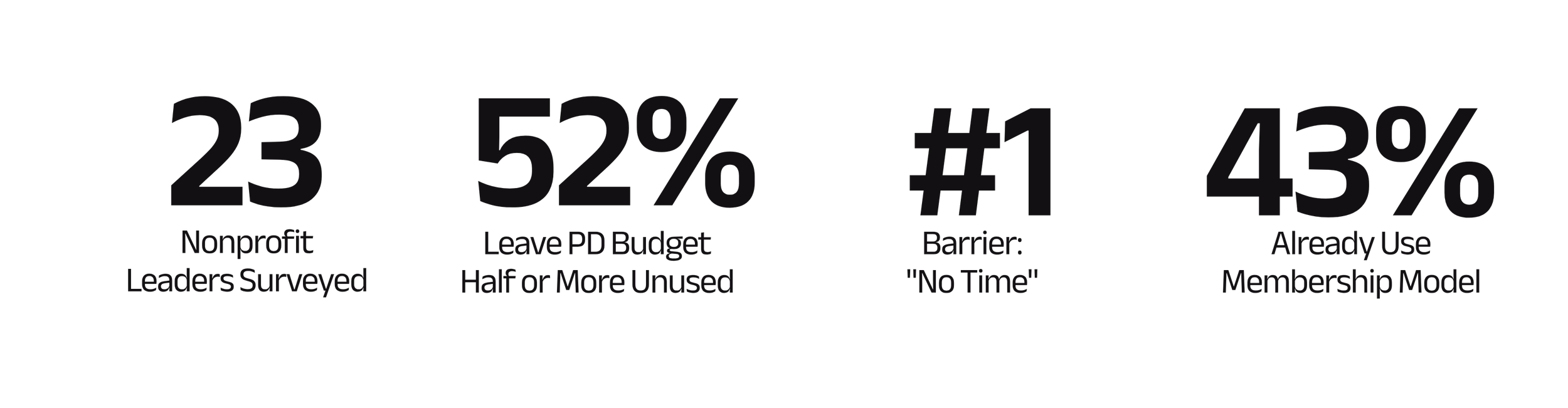
We surveyed 23 nonprofit leaders across the country — and internationally — to understand how they access, use, and feel about professional development. The findings reveal a sector that values growth but keeps getting in its own way. Here's what we learned, and what it means for the work ahead.
“Nonprofit leaders are hungry for professional development — but something keeps getting in the way. Time, guilt, relevance, and a budget that exists mostly on paper. This survey names the gap and points toward what could actually help.”
Between October 26 and November 24, 2025, we surveyed 23 nonprofit leaders representing a wide range of sectors — human services, arts and culture, mental health, education, food security, disability rights, immigration support, and more. Respondents came from the Midwest, South Atlantic, Northeast, Pacific coast, and as far as Kenya and Tanzania.
The goal was simple: understand how professional development actually works (or doesn't) for the leaders doing this hard, essential work. What we found was a clear pattern — and a clear opportunity.
The Budget Landscape:
Money Is There. It's Not Being Used.
The good news: most respondents have a professional development budget. The concerning news: half of them are using less than half of it. This is what we're calling the underutilization crisis — and it's not a money problem. It's a time, access, and culture problem.
Budget Allocation
Budget Utilization
52% of respondents use half or less of their allocated PD budget — not because the money isn't there, but because time, access, and organizational culture get in the way.
The segment with the most budget ($2,501–$5,000 annually, the largest group at 26%) also showed the widest variation in how much they actually spend. Having more money doesn't automatically translate to more investment in self — something deeper is at work here.
What This Means The underutilization gap isn't a budget problem — it's a permission and access problem. Leaders often don't feel entitled to spend on themselves, or don't know where to find resources that are actually worth their limited time.
How They Currently Spend: Familiar Formats, Untapped Potential
The Peer Cohort Gap
Only 21.7% currently participate in peer learning groups or cohorts — yet when asked what formats they want, small group cohorts rank third overall. This is one of the clearest signals in the data: leaders want structured peer learning, but the right offerings haven't found them yet
When leaders do invest in professional development, they lean toward workshops, conferences, and membership dues. What's striking is the massive gap between current usage of peer learning cohorts (21.7%) and demand for them. The market is ahead of the behavior.
Current PD Spending
They're Already Comfortable with Memberships
43.5% of respondents currently pay membership dues as a form of professional development. The membership model isn't new to them — it just needs to deliver more specific, relevant value.
What They Actually Want to Learn
We asked respondents to identify their most pressing professional development needs. The results broke down into three clear tiers — from critical-mass demand to niche interest. Fundraising and leadership development dominate the top, which aligns with where nonprofit leaders feel most stretched and under-resourced.
Topic Demand — Tier 1 (40%+ demand)
Topic Demand — Tier 2 (25–40% demand)
“Transition planning and succession planning both appear in the top demand tiers — which means this isn’t a niche conversation anymore.”
Transition planning (30.4%) and succession planning (26.1%) both showing up in Tier 2 is meaningful. These aren't afterthoughts for these leaders — they're recognized needs. The gap is that very few organizations have built the infrastructure to address them proactively.
How They Want to Learn: Small, Virtual, and Real
Format preferences tell us a great deal about how leaders want to show up for their own development. The top three choices — virtual workshops, 1:1 coaching, and small group cohorts — all share a common thread: intimacy and efficiency. Leaders aren't looking for large, impersonal events. They want connection and practical value.
Format Preferences (All Respondents)
Early Career vs. Veterans
Experience-Based Insight
Early career leaders (0–3 years) skew heavily toward 1:1 coaching and guided cohorts. Veterans (15+ years) prefer multi-day intensives and on-demand, self-directed resources. This suggests that a tiered or experience-segmented offering would serve the full community better than a one-size-fits-all approach.
What Gets in the Way
"No time" is the headline barrier — but it's not the whole story. A close second is not knowing where to find quality resources. Together, these two barriers reveal something important: the problem isn't motivation. It's infrastructure and curation.
Top Barriers to PD Investment
21% of respondents said spending on their own professional development feels selfish or guilty — even when they have a budget explicitly for this purpose. This is a cultural problem, not a financial one.
“When we frame leadership development as a personal perk, we’ve already lost. It’s a fiduciary responsibility to the mission.”
The guilt barrier is particularly worth naming. When leaders feel they shouldn't invest in themselves, they deprioritize the very development that would make them more effective, more sustainable, and better equipped to build succession into their organizations. It's a cycle — and it's one Leaving Well™ work is specifically designed to interrupt.
Price Sensitivity: Value Over Cost
Monthly Investment Tolerance
One of the most encouraging findings in the entire survey: the largest single group (39.1%) said they'd pay "any amount if it fits in my budget" — meaning they're value-sensitive, not price-sensitive. The conversation isn't about being cheap. It's about whether what's being offered is worth their limited time and dollars.
Who Makes the Decision
Pricing Insight
The $50–$100/month range captures the most price-conscious leaders. But 39% will pay whatever is reasonable if the value is clear. The pitch isn't "it's affordable" — it's "here's exactly what you get and why it's worth it."
Who Responded
·
A Snapshot of the field
·
Who Responded
·
Who Responded · A Snapshot of the field · Who Responded ·
The 23 respondents represent a genuinely diverse cross-section of the nonprofit sector — in geography, organization size, experience level, and focus area. Nearly half (47.8%) lead small organizations with 10 or fewer staff. More than half (52%) are top-level leaders (ED or CEO). This is a voice-of-leadership dataset.
Respondent Titles
Organization Size (Staff)
Geographic Distribution
Years of Leadership Experience
What We're Taking Into Our Work
This data doesn't just describe a problem — it maps a path forward. Here are the four things we're leaning into harder because of what these 23 leaders told us:
-
The number one barrier is time. Every offering needs to honor that from the first line of the description. "Two hours a month" isn't a limitation — it's a promise.
-
21% of leaders feel guilty spending on themselves. The framing shift: professional development isn't a perk. It's how you stay equipped to lead the mission, build your successor, and not burn out on the way there.
-
Description text goes here
-
Both topics appear in the top demand tiers. This isn't a niche anymore — nonprofit leaders are actively looking for support here. Leaving Well™ is positioned to meet exactly that need.
Ready to Leave Well?
Whether you're building a succession plan, navigating a leadership transition, or investing in your team's development — the Leaving Well™ framework gives you the tools to do it with clarity and care.